Your Donor Supply Is Finite: The 6,000-Graft Lifetime Limit
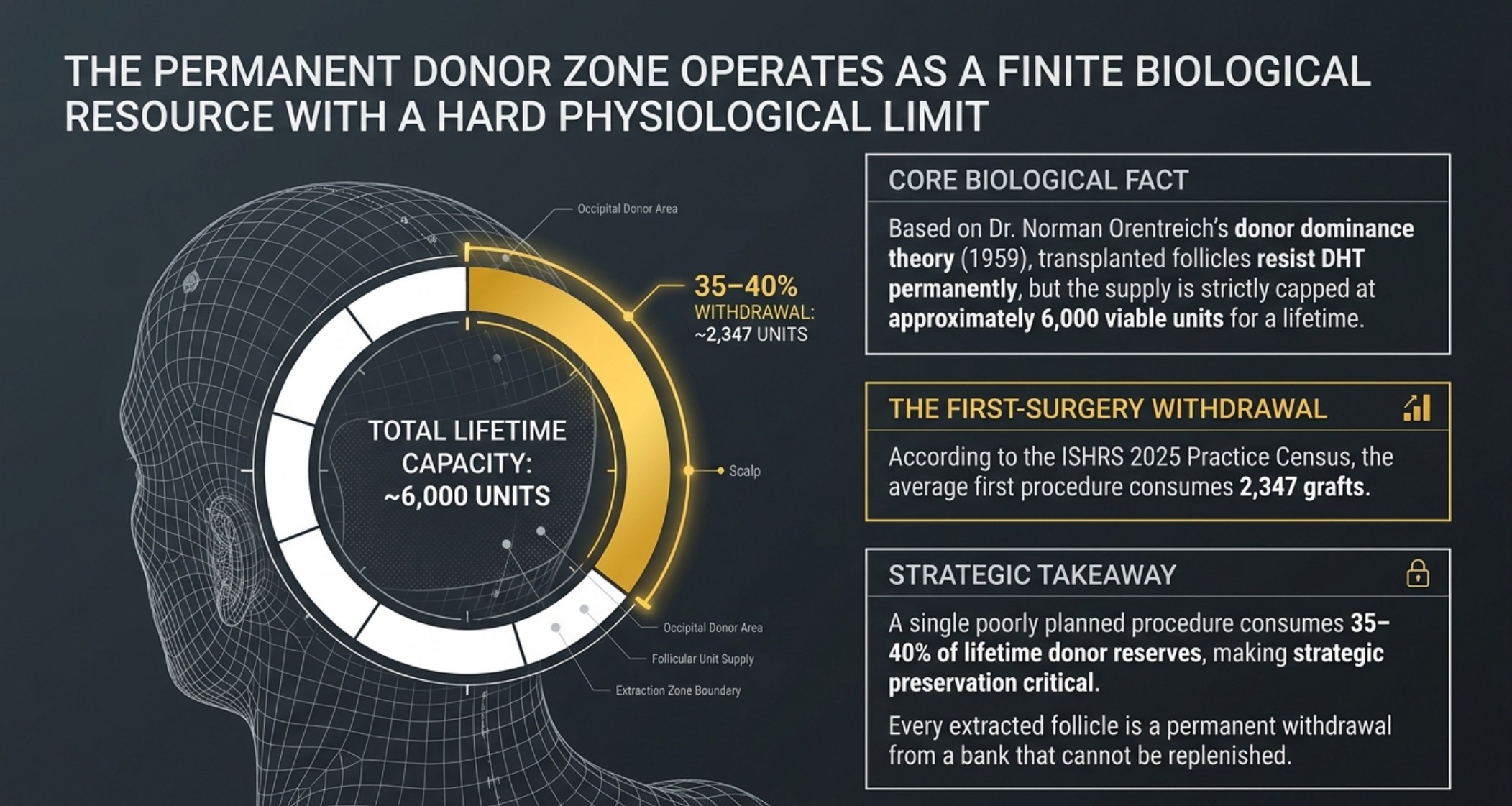
Every hair transplant is a withdrawal from a bank that never takes deposits. The occipital donor zone supports approximately 6,000 viable follicular units for a lifetime, while the average first procedure pulls 2,347 grafts — 35-40% of the entire reserve in one sitting, per the ISHRS 2025 Practice Census. The strategic question is not how many grafts a patient can get today, but what the session leaves behind.
Why the Donor Zone Has a Hard Ceiling
The permanence of transplanted hair rests on donor dominance, Dr. Norman Orentreich's 1959 theory that follicles harvested from the occipital zone keep resisting DHT permanently after relocation. That resistance is why the surgery works at all, and it is also why the supply is strictly capped: only a defined occipital band resists DHT, and the extraction zone boundary has to stop there.
The ~6,000-unit figure is therefore a physiologic limit, not a clinic policy. A structured how-it-works walkthrough treats donor mapping as the first clinical step for exactly this reason. Cells outside the boundary behave differently once transplanted, so stretching the harvest area to chase a higher count trades a short-term number for a long-term deficit.
| Ledger line | Figure | Basis in the deck |
|---|---|---|
| Lifetime donor capacity | ~6,000 viable follicular units | Occipital donor zone (physiologic cap) |
| Average first procedure | 2,347 grafts | ISHRS 2025 Practice Census |
| Share of reserve consumed | 35-40% | Poorly planned single procedure |
| Hair survival basis | Permanent DHT resistance | Orentreich donor dominance, 1959 |
The Anatomy of a 2,347-Graft First Procedure
If lifetime capacity is ~6,000 units and the average first procedure is 2,347 grafts, the arithmetic is blunt: roughly 35-40% of the reserve leaves the scalp in a single session, leaving an implied remainder near 3,653 units. That remainder has to fund every future procedure for the rest of the patient's life.
This is why planning a second procedure during the first is standard practice among elite surgeons, whose volume is benchmarked at up to 15 procedures per month. The cap exists because reserve preservation is a supervision problem — rushed harvests over-extract. A patient in Henderson comparing quotes should ask how much of the 6,000-unit reserve each proposed plan consumes before discussing price.
| Line | Units | Basis |
|---|---|---|
| Lifetime capacity | ~6,000 | Donor zone cap |
| First procedure | 2,347 | ISHRS 2025 Practice Census |
| Share withdrawn by one procedure | 35-40% | Deck figure |
| Implied remainder (6,000 − 2,347) | ~3,653 | Subtraction of the two figures above |
| Safe-practice procedure volume | ~15 per month | ISHRS benchmark for elite practices |
Reading the Reserve as a Lifetime Budget
A donor reserve behaves like a budget with no income: the first procedure's 2,347 grafts and the 6,000-unit ceiling are the two numbers that set every future plan. Two patients can share that identical reserve and still end up with different coverage, because technique, survival rate and time out-of-body each change the effective cost of the same graft count. A plan that spends 35-40% of the reserve at 75-85% survival wastes more of the bank than one spending a similar share at 95-98%.
The practical rule is to treat every proposed graft count as a percentage of 6,000 rather than a raw figure. A 2,347-graft session is roughly 39% of capacity, while a 4,000-graft hybrid megasession consumes about two thirds of it. Framed that way, the trade-off between covering one large area now and preserving density options later becomes visible before any money changes hands. It is also why the ~15 procedures per month benchmark matters to a patient: a practice running far above it leaves less supervised time for the harvest that sets the final count. Henderson patients weighing a Nevada provider should apply that same percentage test to every quote.
Anatomy Decides Which Method Protects the Reserve
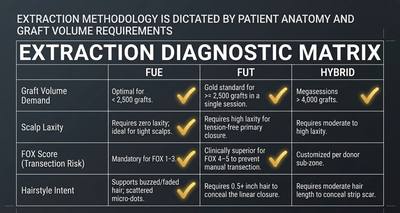
The extraction method should follow anatomy and volume, and each choice spends the reserve differently. FUE is the gold standard below 2,500 grafts; FUT is optimal for megasessions of 2,500 or more in a single session; hybrid is optimal above 4,000. Choosing outside your volume band wastes donor units to extraction error rather than using them for coverage.
Laxity and FOX score finish the filter. FUE needs high laxity for a tension-free primary closure; FUT needs zero laxity and suits tight scalps; hybrid needs moderate-to-high laxity. On transection risk, FUE is clinically superior for FOX 4-5, FUT is mandatory for FOX 1-3, and hybrid is customized per donor sub-zone. A transected follicle is a destroyed unit, which makes technique matching the quietest form of reserve protection.
| Decision factor | FUE | FUT | Hybrid |
|---|---|---|---|
| Graft volume demand | Gold standard < 2,500 grafts | Optimal for megasessions ≥ 2,500 in a single session | Optimal > 4,000 grafts |
| Scalp laxity | Requires high laxity for tension-free primary closure | Requires zero laxity; ideal for tight scalps | Requires moderate-to-high laxity |
| FOX score (transection risk) | Clinically superior for FOX 4-5 | Mandatory for FOX 1-3 | Customized per donor sub-zone |
| Hairstyle intent | Supports buzzed/faded hair; scattered micro-dots | Needs 0.5+ inch hair to conceal closure | Needs moderate length to conceal strip scar |
Survival Rate Is Donor Protection
Every graft that dies is a donor unit spent for nothing. Elite surgeons achieve 95-98% survival; poor execution drops to 75-85%. On a 2,347-graft procedure that spread is the difference between losing a couple of dozen units and losing several hundred — a permanent difference drawn from a fixed reserve.
Delivery and handling control it. Sapphire FUE's V-shaped micro-channels are reported to deliver 10-15% better graft survival and 30% less postoperative inflammation than conventional steel. DHI minimizes bulb manipulation but is capped at roughly 3,500 grafts per session. Limmer data adds the time dimension: survival falls about 1% per hour out-of-body, so cooling near 4°C with ATP solutions is reserve protection, not an accessory. The side-by-side comparisons rank these options directly.
| Factor | Figure | Effect on the reserve |
|---|---|---|
| Elite execution survival | 95-98% | Most harvested units become permanent hair |
| Poor execution survival | 75-85% | Hundreds of units spent for no result |
| Sapphire FUE vs conventional steel | 10-15% better survival; 30% less inflammation | Fewer units lost to handling trauma |
| Out-of-body decay | ~1% per hour | Time in transit is donor loss in slow motion |
| Cooling target | ~4°C with ATP solutions | Slows the ischemia decay curve |
What to Ask Before Spending the Reserve
Ask for the donor estimate in units, the graft count of the proposed plan, and the share of the 6,000-unit reserve it consumes. Ask who performs recipient site creation — the credentialed surgeon or an unlicensed technician. Ask how many procedures the practice runs each month against the ~15 benchmark, and ask for the expected survival rate against the 95-98% band. A patient who receives all four answers has more useful information than any Nevada clinic discount can supply. This article is educational information, not medical advice; a qualified provider should assess the individual case.
Frequently Asked Questions
How much donor hair do I actually have?
Approximately 6,000 viable follicular units for a lifetime — the occipital donor zone's physiologic cap under donor dominance.
How much of it does one transplant use?
The average first procedure consumes 2,347 grafts, or 35-40% of the reserve, according to the ISHRS 2025 Practice Census.
Can I get a second transplant later?
Only from the unused reserve. Survival matters too: elite execution preserves 95-98% of grafts versus 75-85% for poor execution, and every failed graft permanently reduces what is left.
Get matched with hair restoration professionals →
Ready for a Professional Review?
We can connect you with qualified hair restoration professionals who can map your situation to the right treatment.
Get Matched with Hair Restoration Professionals