FUE vs FUT vs Hybrid: Choosing an Extraction Method
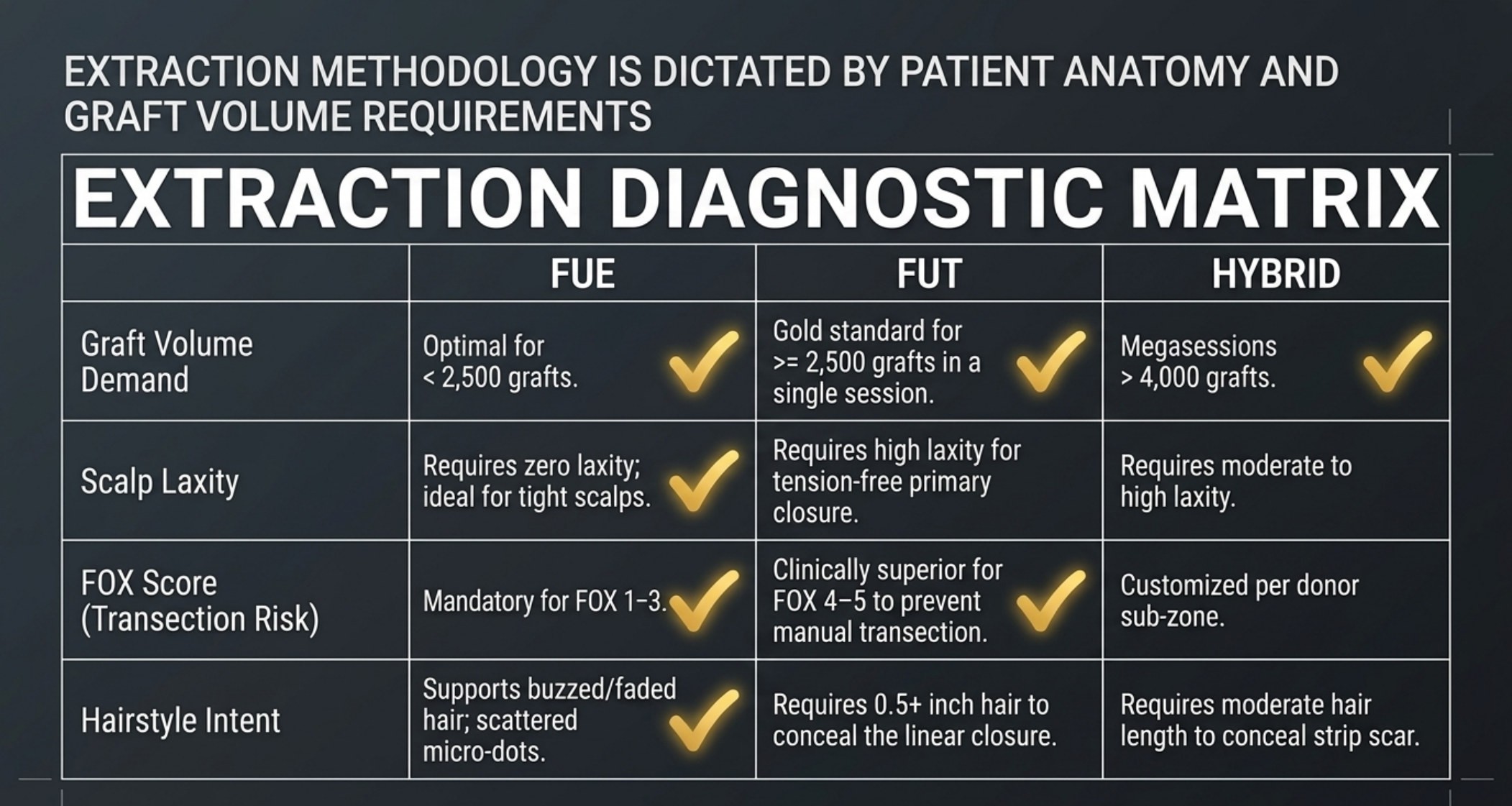
The correct extraction method is dictated by anatomy and graft volume, not by whichever technique a clinic prefers to sell. Three thresholds frame the decision: FUE is the gold standard below 2,500 grafts, FUT is optimal for megasessions of 2,500 grafts or more in a single session, and a hybrid approach is optimal above 4,000 grafts. Laxity, transection risk and hairstyle then refine which of the three fits the individual scalp.
The Volume Thresholds Come First
Volume is the first gate. Below 2,500 grafts, FUE's scattered extraction pattern delivers coverage without a linear closure to conceal. At 2,500 or more in one session, FUT's strip harvest becomes optimal because it concentrates yield. Above 4,000 grafts, hybrid combines both routes to reach a count neither method hits cleanly alone.
The risk of ignoring volume bands is donor waste: an under-powered technique spread too thin leaves density gaps, while an over-powered one spends more donor units than the case requires. Model the target before the method — a slide-by-slide read of the clinical framework follows the same sequence. The full matrix, including laxity, FOX score and hairstyle, is below.
| Decision factor | FUE | FUT | Hybrid |
|---|---|---|---|
| Graft volume demand | Gold standard < 2,500 grafts | Optimal for megasessions ≥ 2,500 in a single session | Optimal > 4,000 grafts |
| Scalp laxity | Requires high laxity for tension-free primary closure | Requires zero laxity; ideal for tight scalps | Requires moderate-to-high laxity |
| FOX score (transection risk) | Clinically superior for FOX 4-5 | Mandatory for FOX 1-3 | Customized per donor sub-zone |
| Hairstyle intent | Supports buzzed/faded hair; scattered micro-dots | Needs 0.5+ inch hair to conceal closure | Needs moderate length to conceal strip scar |
Scalp Laxity as the Gatekeeper
Laxity decides what closes cleanly. FUE requires high laxity for a tension-free primary closure. FUT requires zero laxity and is therefore ideal for tight scalps. Hybrid needs moderate-to-high laxity. A tight scalp pushed into FUE complicates the primary closure, while a highly lax scalp does not need the strip that FUT involves.
This is a mechanical trade-off, not a preference. Because FUT needs zero laxity, it can serve patients whose scalp would not allow a tension-free FUE closure; because FUE needs high laxity, it is not automatically the more advanced option for every scalp. The method follows the tissue.
| Method | Laxity requirement | Why it matters |
|---|---|---|
| FUE | High laxity | Needed for a tension-free primary closure |
| FUT | Zero laxity | Ideal for tight scalps; the strip avoids stretch on the closure |
| Hybrid | Moderate-to-high laxity | Blends extraction routes across the donor zone |
FOX Score and Transection Risk
The FOX score routes transection risk, and it is where technique choice stops being cosmetic. FUE is clinically superior for FOX 4-5 to prevent manual transection. FUT is mandatory for FOX 1-3. Hybrid is customized per donor sub-zone. On lower FOX scores, moving to FUT is not an upsell but a transection-avoidance decision, because a transected follicle is a destroyed donor unit with no path back into the reserve.
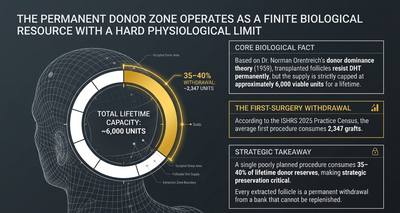
Transection risk also compounds with the lifetime donor ceiling: the occipital zone supports approximately 6,000 viable follicular units, and the average first procedure already consumes 2,347 grafts. Units lost to transection are subtracted from a supply that cannot be replenished, so the FOX score is a reserve-protection dial as much as a technique selector.
| FOX score / risk band | Method | Rationale in the deck |
|---|---|---|
| FOX 4-5 | FUE | Clinically superior to prevent manual transection |
| FOX 1-3 | FUT | Mandatory at these scores |
| Customized | Hybrid | Matched per donor sub-zone |
Hairstyle Intent and Concealment
Hairstyle intent sets a hard constraint. FUE supports buzzed or faded hair because it leaves only scattered micro-dots. FUT requires at least 0.5 inch of hair length to conceal the linear closure. Hybrid requires moderate hair length to conceal the strip scar. A patient committed to a cropped cut and a patient comfortable above 0.5 inch are running two different calculations on the same scalp.
Concealment is not vanity; it is a maintenance commitment. FUE's micro-dots ask nothing of the patient, while FUT and hybrid both impose a minimum length that must hold for as long as the patient wants the closure hidden. When a scalp sits near a volume boundary and two methods are both viable, the hairstyle requirement is often the deciding trade-off.
| Aftercare hairstyle | FUE | FUT | Hybrid |
|---|---|---|---|
| Buzzed / faded | Supported; scattered micro-dots | Not suitable | Not suitable |
| Minimum hair length to conceal | Scattered micro-dots, no line | 0.5+ inch | Moderate length (strip scar) |
| Strip scar visibility | None | Linear closure | Strip scar to conceal |
Volume, Cost and the Donor Ceiling
Method choice interacts with both the lifetime ceiling and price. US benchmarks run $6-$10 per graft for ARTAS robotic FUE, $4-$6 for manual FUE, and $3-$5 for FUT; Turkey and global benchmarks run $1.50-$3.00 for DHI, $1.50-$2.50 for Sapphire FUE, and $1.00-$2.00 for manual FUE. A high price does not guarantee quality, and a low price does not guarantee a bargain.
Execution still dominates the ledger. Elite surgeons reach 95-98% graft survival while poor execution drops to 75-85%, and Sapphire FUE's V-shaped channels are reported to deliver 10-15% better survival plus 30% less inflammation than conventional steel. DHI, which merges incision and placement into one step, is capped at roughly 3,500 grafts per session. Verify who creates the recipient sites — the credentialed surgeon or an unlicensed technician — and check regional pricing through the cost guide. Henderson patients comparing Nevada options should weight survival and reserve preservation ahead of the per-graft quote, and the FAQ library covers the questions worth asking first. This article is educational information, not medical advice; a qualified provider should assess the individual case.
Deciding in Sequence
Work the factors in order: volume band first, then laxity, then FOX score, then hairstyle. Volume narrows the field to one or two methods, laxity confirms which closures are mechanically safe, FOX score protects the reserve from transection, and hairstyle settles any remaining tie. Deciding in that sequence turns three techniques into a single anatomically justified answer.
The sequence also exposes weak consultations. A provider who opens with a technique and works backward to the anatomy has skipped the two steps that protect the donor bank, and one who quotes per-graft pricing before measuring laxity and FOX score has priced a case that is not yet defined. For a patient in Henderson, the fastest test of a local consultation is whether volume, laxity, FOX score and hairstyle are all addressed before the price is mentioned.
Frequently Asked Questions
Is FUE always better than FUT?
No. FUE is the gold standard below 2,500 grafts, but FUT is optimal for megasessions of 2,500 or more in a single session and is mandatory for FOX 1-3 to prevent manual transection.
When is a hybrid approach used?
Hybrid is optimal above 4,000 grafts and requires moderate-to-high scalp laxity. It customizes the harvest per donor sub-zone and needs moderate hair length to conceal the strip scar.
Does the extraction method change my hairstyle options?
Yes. FUE supports buzzed or faded hair with scattered micro-dots; FUT needs at least 0.5 inch of length to hide the linear closure; hybrid needs moderate length to conceal the strip scar.
Get matched with hair restoration professionals →
Ready for a Professional Review?
We can connect you with qualified hair restoration professionals who can map your situation to the right treatment.
Get Matched with Hair Restoration Professionals