The Five Variables That Decide Your Hair Transplant Outcome
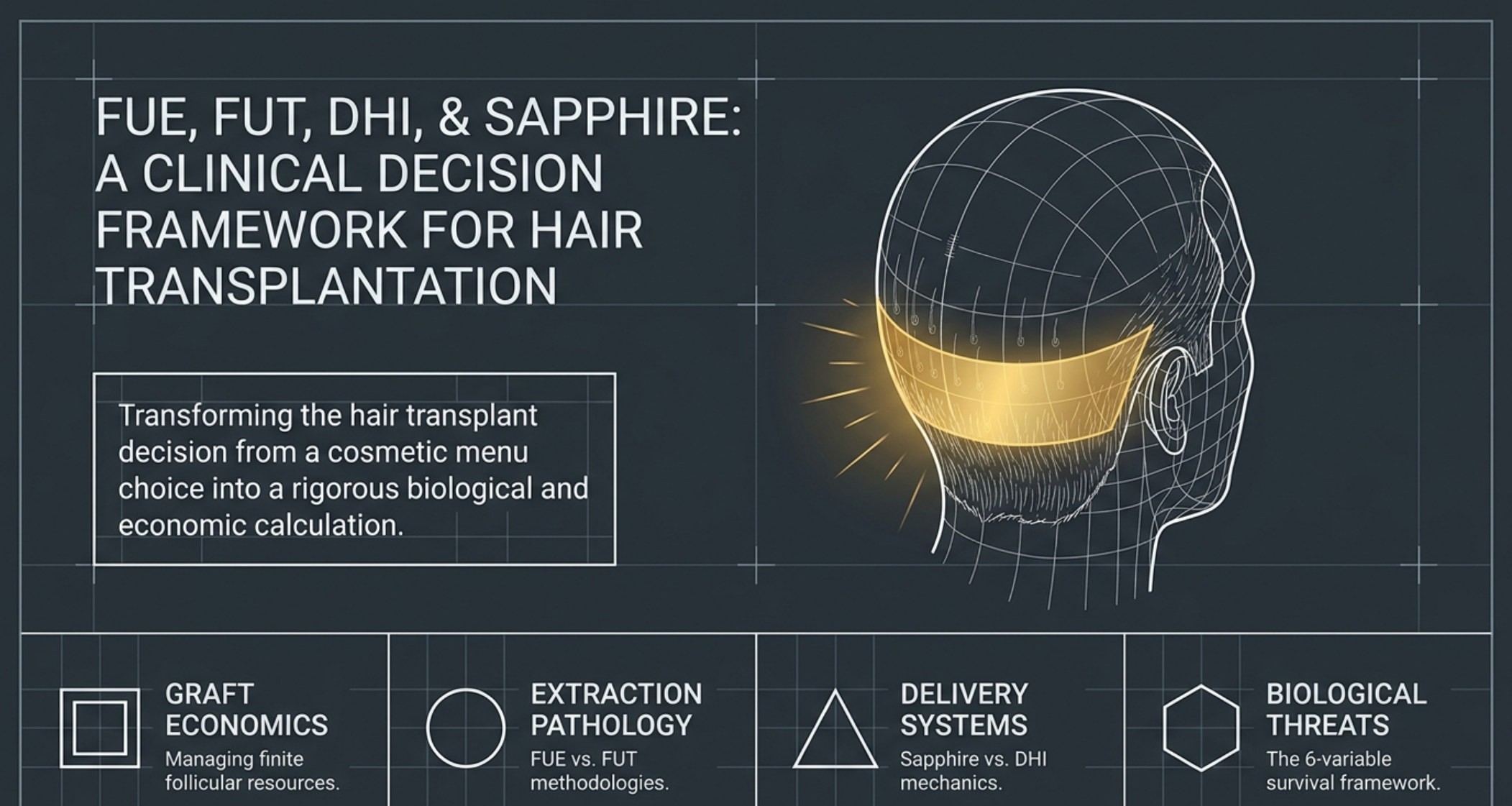
A hair transplant is sold as a menu: pick a technique, pick a clinic, pick a price. The survival data says the outcome is decided elsewhere. Across the same procedure, elite surgeons reach 95-98% graft survival while poor execution drops to 75-85% — a spread that no single technique choice explains. Five variables drive that gap: graft pathology, extraction systems, delivery mechanics, biological threats, and economics. Sequence them correctly and the result behaves like a permanent relocation of DHT-resistant follicles; miss one and the deficit compounds.
Variable One: Graft Pathology and the Finite Donor Bank
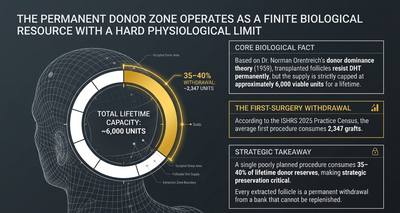
Everything starts with donor dominance — Dr. Norman Orentreich's 1959 theory that follicles taken from the occipital donor zone keep resisting DHT permanently, wherever they are relocated. That permanence is the premise of surgery, and it arrives with a hard ceiling: the donor zone supports approximately 6,000 viable follicular units across a lifetime.
Against that ceiling, the ISHRS 2025 Practice Census reports that the average first procedure consumes 2,347 grafts. A single poorly planned session withdraws 35-40% of lifetime donor reserves, so the extraction zone boundary drawn in the first consultation determines what remains for decades. Every extracted follicle is a permanent withdrawal from a bank that cannot be replenished. Before comparing techniques, model the reserve — the graft planning tools exist for exactly this arithmetic.
| Metric | Figure |
|---|---|
| Lifetime donor capacity (occipital zone) | ~6,000 viable follicular units |
| Average first procedure | 2,347 grafts (ISHRS 2025 Practice Census) |
| Share of lifetime reserve spent in one poor plan | 35-40% |
| DHT resistance of transplanted follicles | Permanent (Orentreich donor dominance, 1959) |
Variable Two: Extraction Systems
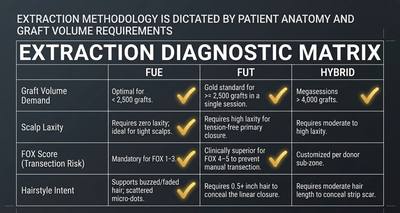
Methodology follows anatomy and volume, not preference. FUE is the gold standard below 2,500 grafts; FUT is optimal for megasessions of 2,500 grafts or more in a single session; a hybrid approach is optimal above 4,000 grafts. Those thresholds are the decision, not the marketing around it.
Laxity then filters the choice. FUE requires high laxity for a tension-free primary closure, FUT requires zero laxity and suits tight scalps, and hybrid work needs moderate-to-high laxity. FOX score routes the transection risk: FUE is clinically superior for FOX 4-5 to prevent manual transection, FUT is mandatory for FOX 1-3, and hybrid is customized per donor sub-zone. The table below lays out the same routing used in clinical planning.
| Decision factor | FUE | FUT | Hybrid |
|---|---|---|---|
| Graft volume demand | Gold standard < 2,500 grafts | Optimal for megasessions ≥ 2,500 in a single session | Optimal > 4,000 grafts |
| Scalp laxity | Requires high laxity for tension-free primary closure | Requires zero laxity; ideal for tight scalps | Requires moderate-to-high laxity |
| FOX score (transection risk) | Clinically superior for FOX 4-5 | Mandatory for FOX 1-3 | Customized per donor sub-zone |
| Hairstyle intent | Supports buzzed/faded hair; scattered micro-dots | Needs 0.5+ inch hair to conceal closure | Needs moderate length to conceal strip scar |
Variable Three: Delivery Mechanics
Once grafts are out of the body, the geometry of the recipient channel helps decide how many survive. Conventional steel creates a U-shaped incision with elevated lateral tissue trauma. Sapphire FUE uses a synthetic single-crystal blade to cut precise V-shaped micro-channels, and trials report 10-15% better graft survival plus 30% less postoperative inflammation. DHI goes further, merging incision and placement into one step with a hollow mechanical needle, which minimizes bulb manipulation and gives extreme control over exit angles for dense packing — capped at roughly 3,500 grafts per session.
| Delivery system | Incision / mechanism | Reported data |
|---|---|---|
| Conventional steel | U-shaped incision; elevated lateral tissue trauma | — |
| Sapphire FUE | Synthetic single-crystal blade cuts precise V-shaped micro-channels | 10-15% better graft survival; 30% less postoperative inflammation |
| DHI Choi pen | Hollow mechanical needle merges incision and placement into one step | Minimizes bulb manipulation; capped at ~3,500 grafts per session |
Variable Four: Biological Threats
Six threats decide whether a graft lives: ischemia from out-of-body time, transection from hidden crush damage to the bulb, recipient architecture that must match graft caliber to native flow, dehydration from cellular desiccation, density staging that prevents vascular necrosis from over-packing, and temperature held near 4°C with ATP solutions.
Limmer data traces the ischemia decay curve directly: graft survival falls approximately 1% per hour out-of-body. That single slope accounts for much of the distance between the 95-98% elite band and the 75-85% floor, which is why time-in-transit discipline matters more than technique branding. A shortlisted clinic's answers on cooling and staging are worth more than its price list.
Variable Five: Economics
Price is a variable, not a verdict. US benchmarks run $6-$10 per graft for ARTAS robotic FUE, $4-$6 for manual FUE, and $3-$5 for FUT. Turkey and global benchmarks run $1.50-$3.00 for DHI, $1.50-$2.50 for Sapphire FUE, and $1.00-$2.00 for manual FUE. A high price does not guarantee quality, and a low price does not guarantee a bargain.
The ISHRS benchmark for safe, elite practices is a strict limit of roughly 15 procedures per month — a volume that keeps every step supervised. Patients must also verify who personally executes recipient site creation: the credentialed surgeon, or an unlicensed technician. That single question, paired with the regional figures in the Henderson cost guide, exposes more about value than any quoted total.
| Region | Technique | Range per graft |
|---|---|---|
| US benchmark | ARTAS robotic FUE | $6-$10 |
| US benchmark | Manual FUE | $4-$6 |
| US benchmark | FUT | $3-$5 |
| Turkey / global | DHI | $1.50-$3.00 |
| Turkey / global | Sapphire FUE | $1.50-$2.50 |
| Turkey / global | Manual FUE | $1.00-$2.00 |
How the Five Variables Interact
The five variables are not independent. A tight scalp that fails the laxity test for FUE pushes the plan toward FUT, which in turn raises the hairstyle requirement to conceal the linear closure. A FOX score at 1-3 is routed to FUT for transection protection, which changes both the delivery method and the concealment timeline. Each constraint reshapes the next, so a per-graft quote that arrives before the anatomy is measured is answering a question nobody asked.
The clearest sign of poor sequencing is a plan that fixes the graft count first and reverse-engineers the rest. A 2,347-graft first procedure already consumes 35-40% of the reserve; stacking a technique mismatch on top of that wastes donor units that cannot be replaced. When a provider can name the volume band, the laxity finding, the FOX score and the concealment requirement in one pass, the plan is being built in the right order.
Sequencing the Five Variables
Draw the donor reserve first, let anatomy and volume pick the extraction system, then match delivery mechanics and threat control to the caliber and count you actually have. Economics sits last, because reading technique comparisons before the reserve is drawn produces confident answers to the wrong question. Henderson patients weighing their Nevada options should treat a provider's ability to walk through all five variables in one sitting as the real filter. This article is educational information, not medical advice; a qualified provider should assess the individual case.
Frequently Asked Questions
How many grafts can one session produce?
FUE is the gold standard below 2,500 grafts, FUT is optimal for 2,500 or more in a single session, and hybrid approaches are used above 4,000. DHI delivery is capped at roughly 3,500 grafts per session.
Why do two clinics quote different survival rates?
Elite surgeons reach 95-98% survival while poor execution lands at 75-85%. Most of that gap comes from the six biological threats — especially ischemia, which costs about 1% of survival per hour out-of-body.
What is the lifetime limit on donor hair?
Approximately 6,000 viable follicular units. The average first procedure takes 2,347 grafts, or 35-40% of that reserve, per the ISHRS 2025 Practice Census.
Get matched with hair restoration professionals →
Ready for a Professional Review?
We can connect you with qualified hair restoration professionals who can map your situation to the right treatment.
Get Matched with Hair Restoration Professionals